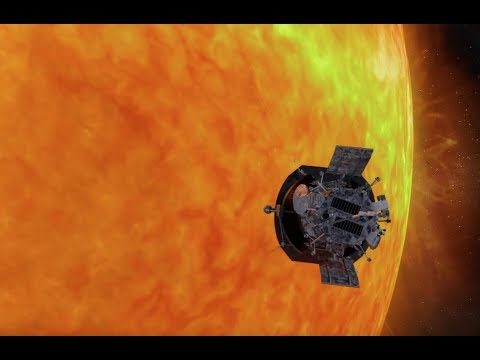
Dr. Elena Vasquez had been waiting for this moment her entire 30-year career in astrophysics. Standing in the control room at Johns Hopkins Applied Physics Laboratory, she watched the data stream in real-time from a spacecraft traveling faster than anything humans had ever built. Her hands trembled slightly as she realized what she was seeing.
“This is it,” she whispered to her colleague. “We’re actually touching the Sun.”
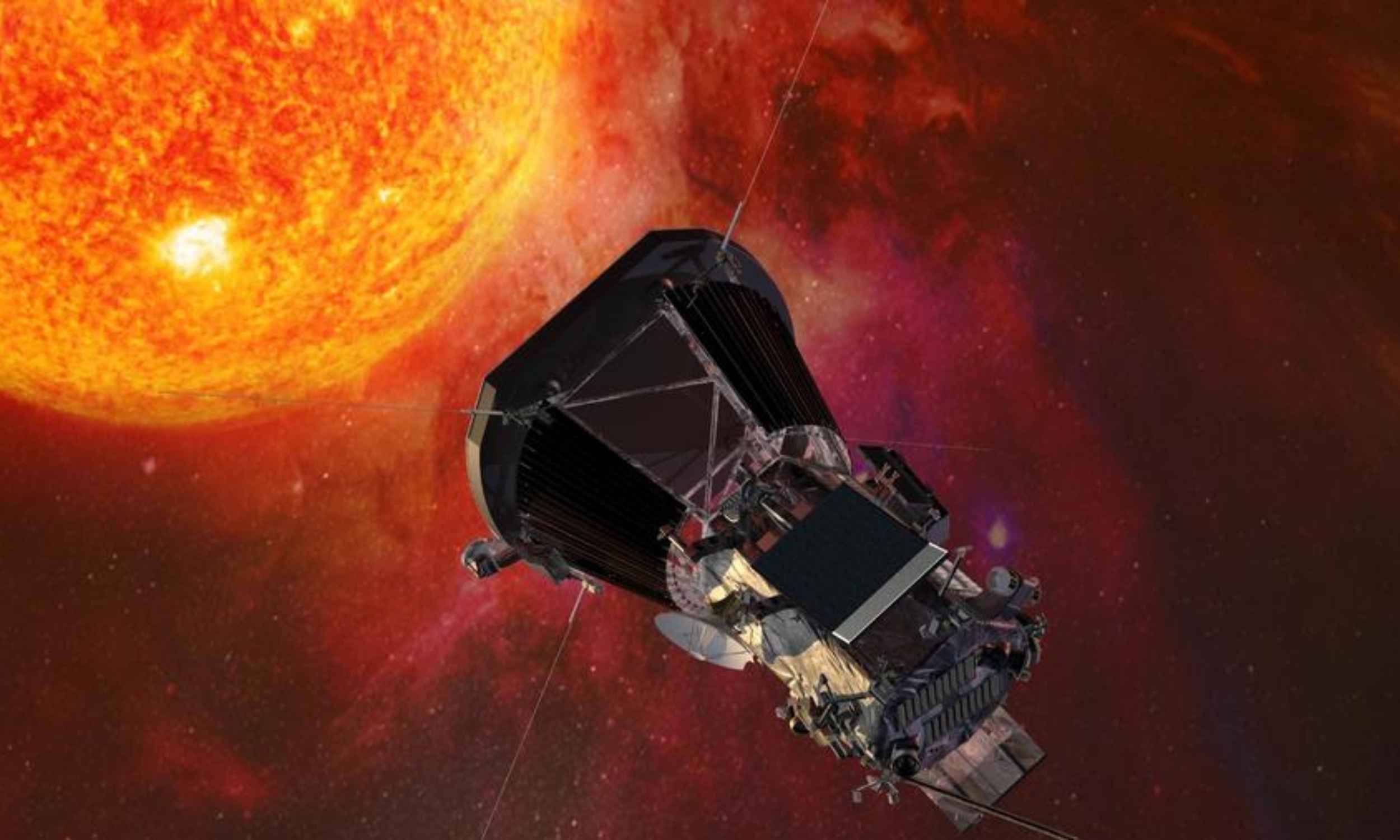
The Parker Solar Probe had just accomplished something that seemed impossible just decades ago—it flew through the Sun’s corona, our star’s outermost atmosphere, at a mind-bending 429,000 miles per hour. The data it collected during this historic flyby could finally answer questions that have puzzled scientists since the dawn of astronomy.
A Journey Into Hell That Could Rewrite Science
Imagine trying to study a campfire by flying a paper airplane directly through the flames. That’s essentially what NASA’s Parker Solar Probe just did with the Sun, except the “campfire” is a million degrees hot and the “paper airplane” is humanity’s most sophisticated spacecraft.
The probe’s recent close encounter brought it within 3.8 million miles of the Sun’s surface—closer than any human-made object has ever ventured. To put that in perspective, if Earth and the Sun were at opposite ends of a football field, Parker would be standing just four yards from our star.
But distance isn’t the only record-breaking aspect of this mission. The spacecraft’s incredible speed of 429,000 mph makes it the fastest object ever built by humans. At that velocity, you could travel from New York to Los Angeles in less than 20 seconds.
The data we’re receiving is unlike anything we’ve ever seen before. It’s like having a front-row seat to the most powerful show in our solar system.
— Dr. Nour Raouafi, Parker Solar Probe Project Scientist
The probe didn’t just survive this hellish journey—it thrived. Protected by a revolutionary heat shield made of carbon-composite materials, Parker endured temperatures exceeding 2,500 degrees Fahrenheit while its instruments remained at a comfortable room temperature.

The Mystery That’s Baffled Scientists for Centuries
Here’s something that doesn’t make sense: the Sun’s surface temperature is about 10,000 degrees Fahrenheit, but its atmosphere—the corona—reaches temperatures of over 2 million degrees. It’s like discovering that the air around a campfire is somehow 200 times hotter than the fire itself.
This phenomenon, known as the coronal heating problem, has stumped scientists for generations. How can the corona be so much hotter than the surface that creates it? It defies our basic understanding of how heat works.
The Parker Solar Probe’s latest data collection could finally crack this cosmic puzzle. Here’s what makes this mission so crucial:
- First direct measurements from within the solar corona
- Real-time data on solar wind acceleration and heating
- Detailed observations of magnetic field behavior near the Sun
- High-resolution images of coronal structures and solar flares
- Particle measurements that could explain space weather patterns
We’re not just observing the Sun anymore—we’re actually sampling it. That’s the difference between looking at a waterfall from a distance and sticking your hand directly into the rushing water.
— Dr. Stuart Bale, University of California Berkeley
What This Breakthrough Could Mean for Earth
The implications of solving the coronal heating mystery extend far beyond satisfying scientific curiosity. Understanding how the Sun’s corona works could revolutionize our ability to predict space weather—solar storms that can wreak havoc on Earth’s technology.
Solar storms aren’t just a theoretical concern. In 1989, a massive solar flare knocked out power grids across Quebec, leaving millions without electricity for nine hours. A similar event today could cause trillions of dollars in damage to our increasingly connected world.
| Parker Solar Probe Key Stats | Details |
|---|---|
| Maximum Speed | 429,000 mph |
| Closest Approach | 3.8 million miles from Sun |
| Heat Shield Temperature | 2,500°F |
| Mission Duration | 7 years (2018-2025) |
| Total Solar Encounters | 24 planned flybys |
| Launch Cost | $1.5 billion |
The probe’s findings could help us:
- Predict dangerous solar flares with greater accuracy
- Protect astronauts from deadly solar radiation
- Safeguard satellite communications and GPS systems
- Prevent power grid failures caused by geomagnetic storms
- Improve our understanding of other stars in the universe
Every piece of technology we rely on—from cell phones to power grids—is vulnerable to solar activity. Parker’s data could be the key to protecting our modern way of life.
— Dr. Nicola Fox, NASA Heliophysics Division Director
The Human Story Behind the Science
This mission represents more than just technological achievement—it’s a testament to human curiosity and determination. The Parker Solar Probe is named after Dr. Eugene Parker, the legendary astrophysicist who first theorized the existence of solar wind in 1958. At 91 years old, Parker witnessed the launch of the spacecraft bearing his name, making him the first living person to have a NASA mission named in their honor.
The engineering challenges seemed insurmountable when the mission was first proposed. How do you build something that can survive temperatures hot enough to melt copper while maintaining the precision needed for scientific measurements? The answer required breakthrough innovations in materials science, thermal protection, and autonomous navigation.
We’re essentially building a spacecraft that can fly through hell and come back to tell us what it saw. The engineering challenges were unlike anything we’d ever attempted.
— Andy Driesman, Parker Solar Probe Project Manager
The data collected during this latest solar encounter is still being analyzed, but early results are already generating excitement in the scientific community. Some measurements are challenging existing theories about solar physics, while others are confirming long-held hypotheses about our star’s behavior.
What Happens Next
This isn’t the end of Parker’s journey—it’s just the beginning of the most exciting phase. The probe is scheduled for several more close encounters with the Sun, each one bringing it closer and revealing new secrets about our star.
Scientists expect the full analysis of this latest data collection to take months, possibly years. But the preliminary findings are already reshaping our understanding of the Sun and its influence on our solar system.
For those of us here on Earth, Parker’s discoveries could lead to better space weather forecasting, improved satellite technology, and a deeper appreciation for the delicate balance that makes life on our planet possible.
FAQs
How does the Parker Solar Probe survive such extreme heat?
The spacecraft uses a revolutionary heat shield made of carbon-composite materials that can withstand temperatures over 2,500°F while keeping the instruments at room temperature.
Why is the Sun’s corona hotter than its surface?
This is one of science’s biggest mysteries. The corona reaches over 2 million degrees while the surface is only 10,000 degrees, defying our normal understanding of heat transfer.
How fast is 429,000 mph in practical terms?
At that speed, you could travel from Los Angeles to New York in about 20 seconds, making it the fastest human-made object ever built.
When will we know the results of this mission?
Scientists are analyzing the data now, but full results could take months to years to process and understand completely.
How could this research affect daily life on Earth?
Better understanding of solar activity could improve predictions of space weather that affects power grids, satellites, GPS systems, and communication networks.
Is this Parker’s final mission to the Sun?
No, the probe is scheduled for multiple additional close encounters with the Sun through 2025, each providing more valuable data about our star.